Phoenix, Arizona
(480) 206-4507sales@santechservices.comCustomer PortalLMS Login
SANTECH
Services
Products & Services
About
Customers
Resources
Contact
Get a Quote
Get Started

Ready to Elevate Your
Technical Operations?

Let's discuss how SANTECH can support your documentation and training needs.

Request A Quote
SANTECH
Services

Providing high-quality technical documentation, instructor-led training, and tailored eLearning solutions for technology-oriented organizations.

(480) 206-4507sales@santechservices.com
Phoenix, AZ

Products & Services

  • Training Platform
  • Technical Documentation
  • In-Person Training
  • eLearning
  • Video Production

Company

  • About Us
  • Customers

Resources

  • Resource Library
  • Request a Proposal
  • Customer Portal
  • Contact Us

Newsletter

Stay updated with our latest insights.

© 2026 SANTECH Services. All rights reserved.

Privacy PolicyTerms of Service
Why Generic LMS Platforms Fail in Warehouses and Distribution Centers
Back to Resources
eLearning

Why Generic LMS Platforms Fail in Warehouses and Distribution Centers

March 10, 20268 min readSANTECH Team

If you manage training for a warehouse, distribution center, or sortation facility, you've probably evaluated a handful of LMS platforms. Most of them look impressive in the demo. Clean dashboards, drag-and-drop course builders, integration badges for every HR tool on the market. But once you try to deploy them on the floor, the cracks show fast.

The problem isn't that these platforms are bad. It's that they were built for a different world – one where learners sit at desks, training is a quarterly checkbox, and the content is a slideshow about data privacy. Warehouses don't work that way.

The Content Problem

Generic LMS platforms assume your training content already exists and just needs a place to live. Upload your SCORM package, assign it to a group, done. But in industrial environments, the content gap is the real bottleneck. You don't need a platform that hosts slides – you need courses that show an operator exactly how to clear a jam on a merge conveyor, or walk a technician through a lockout/tagout procedure for a specific piece of equipment.

That kind of content doesn't come from a template library. It has to be filmed on your floor, with your equipment, following your SOPs. Most LMS vendors don't offer that. They sell you the shelf and expect you to fill it.

The Context Problem

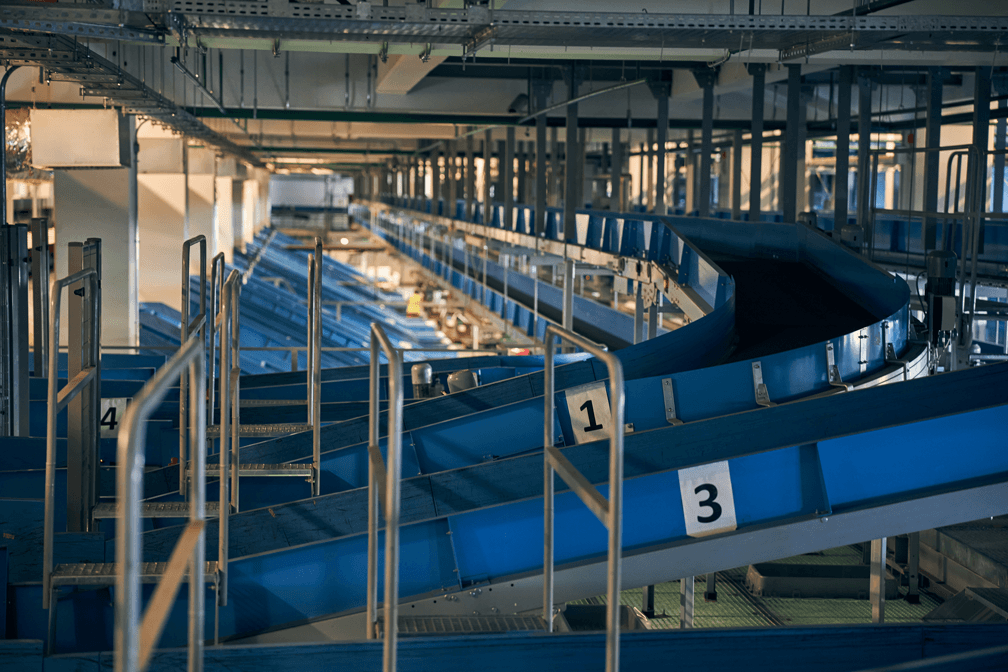
In an office environment, a flat list of courses works fine. In a sortation facility with dozens of subsystems, operators need training that maps to their physical environment. Which courses apply to the induction area? What training does a technician need before working on the divert stations?

Generic platforms have no concept of equipment zones, system maps, or location-based training paths. They organize content by department or job title – categories that mean nothing when an operator is standing in front of a piece of equipment they've never been trained on.

The Access Problem

Warehouse employees typically don't have company email addresses, personal laptops, or Active Directory accounts. Many LMS platforms assume all three. SSO integrations that rely on Microsoft Entra or Google Workspace are useless for a workforce that clocks in with a badge number.

The onboarding friction alone kills adoption. If a new hire can't get into the system within five minutes of sitting down for orientation, you've lost them. They'll do the training on paper, and your LMS becomes expensive shelfware.

The Reporting Problem

Compliance reporting in a warehouse isn't 'how many people completed the annual harassment training.' It's 'can every operator on the night shift prove they've completed LOTO training for the subsystems they're assigned to?' It's 'which new hires from last month haven't finished their safety onboarding?'

Generic platforms give you completion percentages and pie charts. Industrial operations need reports tied to equipment, shifts, and regulatory requirements. If you can't pull a report that shows OSHA compliance by facility zone in under a minute, your platform isn't built for this.

The Administration Problem

Here's the part that rarely comes up in the sales demo: who's going to run this thing? Most warehouse operations don't have a dedicated L&D team. The safety manager, the ops director, or an HR generalist ends up as the accidental LMS administrator – on top of their actual job.

A platform that requires a full-time admin to manage enrollments, update content, troubleshoot SCORM packages, and generate reports is a platform that will be neglected within six months. Industrial operations need either a radically simple admin experience or a managed service that handles administration for them.

What to Look for Instead

If you're evaluating an LMS for a warehouse or distribution environment, here's the short list of what actually matters:

  • Content creation services – not just hosting. Can the vendor film, develop, and maintain your training content?
  • Equipment-mapped training – system maps, zone-based course assignments, and training tied to physical locations.
  • Simple access – credential-based login that works for hourly employees without corporate email.
  • Compliance-ready reporting – reports by equipment zone, shift, and regulatory requirement, not just completion rates.
  • Managed administration – someone who will run the platform for you, or a UI simple enough that your safety manager can handle it in 15 minutes a week.

The LMS market is saturated with platforms optimized for knowledge workers. If your workforce operates forklifts instead of laptops, you need a platform built for your reality – not adapted from someone else's.

Ready to build your eLearning program?

Let’s discuss how SANTECH can help you develop eLearning, deploy an LMS, or design a blended training program.

Get in Touch
Keep Reading

Related Articles

How to Evaluate a Documentation and Training Partner
Documentation
February 21, 20267 min read

How to Evaluate a Documentation and Training Partner

Choosing the wrong documentation partner is expensive. Here's how to evaluate them before the contract is signed.

Read This Article

Build vs. Outsource: The Real Cost of Producing Documentation and Training In-House
Documentation
February 21, 20266 min read

Build vs. Outsource: The Real Cost of Producing Documentation and Training In-House

Most organizations underestimate the true cost of producing documentation and training internally. Here's how to think about the build-vs.-outsource decision.

Read This Article
Why Documentation Strategy Is the Competitive Edge Most OEMs Ignore
Documentation
February 15, 20265 min read

Why Documentation Strategy Is the Competitive Edge Most OEMs Ignore

Structured authoring, single-source publishing, and scalable content strategies are turning documentation from a cost center into a competitive differentiator.

Read This Article
IETMs Have Outgrown the Manual — Here's What They're Becoming
Documentation
February 18, 20266 min read

IETMs Have Outgrown the Manual — Here's What They're Becoming

Interactive Electronic Technical Manuals started as searchable PDFs. Now they're evolving into intelligent platforms that blend documentation, diagnostics, and training into one system.

Read This Article
Your AI Agent Is Only as Good as Your Documentation and Training
Training
February 1, 20266 min read

Your AI Agent Is Only as Good as Your Documentation and Training

Everyone's talking about AI agents for maintenance. Nobody's talking about what those agents actually need to work: structured documentation and well-designed training content.

Read This Article
Measuring ROI on eLearning Investments in Manufacturing
eLearning
January 20, 20266 min read

Measuring ROI on eLearning Investments in Manufacturing

Key metrics and strategies for demonstrating the value of digital learning programs in industrial settings.

Read This Article
Your Engineers Are Not Your Documentation Team
Documentation
February 21, 20266 min read

Your Engineers Are Not Your Documentation Team

When engineers and project managers are pulled off core work to produce manuals and training materials, the costs show up in every part of the business.

Read This Article
When Documentation Is the Bottleneck, Quality Is the First Casualty
Documentation
February 21, 20266 min read

When Documentation Is the Bottleneck, Quality Is the First Casualty

Timeline pressure and documentation quality are connected. When docs are always the last thing finished, they're also the least likely to be finished well.

Read This Article
The Hidden Costs of Documentation Nobody Is Tracking
Documentation
February 21, 20266 min read

The Hidden Costs of Documentation Nobody Is Tracking

Most organizations can't tell you what documentation actually costs. That gap between perception and reality is quietly eroding project margins.

Read This Article
Meeting Customer Documentation Specs Without the Rework Cycle
Documentation
February 21, 20265 min read

Meeting Customer Documentation Specs Without the Rework Cycle

When customer documentation requirements are unclear or underestimated, the result is rework, delays, and strained relationships.

Read This Article
Customer Training Is Not a Cost Center — It Is a Competitive Advantage
Training
February 21, 20266 min read

Customer Training Is Not a Cost Center — It Is a Competitive Advantage

OEMs that treat customer training as an afterthought are leaving revenue on the table and creating support burdens they don't need to have.

Read This Article
When Vendor Documentation Is Not Enough: Filling the Gaps Your Teams Live With
Documentation
February 21, 20266 min read

When Vendor Documentation Is Not Enough: Filling the Gaps Your Teams Live With

Most operations teams know the problem: vendor documentation that's inconsistent, incomplete, or impossible to apply to your actual operating environment.

Read This Article
Tribal Knowledge Is Not a Training Program
Training
February 21, 20267 min read

Tribal Knowledge Is Not a Training Program

When your organization's operational know-how lives in people's heads instead of documented procedures and training programs, every departure is a loss.

Read This Article
Compliance Documentation Gaps Are a Risk You Can't Afford to Ignore
Documentation
February 21, 20265 min read

Compliance Documentation Gaps Are a Risk You Can't Afford to Ignore

When your documentation doesn't meet current regulatory and safety requirements, the risk isn't theoretical — it's operational, legal, and financial.

Read This Article
The Real Cost of Untrained Sortation Operators
Training
March 5, 20267 min read

The Real Cost of Untrained Sortation Operators

Untrained operators don't just make mistakes – they create compounding costs across safety, throughput, equipment, and compliance. Here's what the numbers actually look like.

Read This Article
LMS Administration: Who Actually Runs Your Training Platform?
eLearning
February 28, 20266 min read

LMS Administration: Who Actually Runs Your Training Platform?

You bought the LMS. You loaded the courses. Six months later, nobody's updating it. Here's why LMS administration is the hidden bottleneck – and how to solve it.

Read This Article
Blended Learning: Why the Best Industrial Training Programs Use Both eLearning and Hands-On
eLearning
March 10, 20267 min read

Blended Learning: Why the Best Industrial Training Programs Use Both eLearning and Hands-On

eLearning handles the knowledge. In-person handles the equipment. Here's how blended learning programs reduce training time while improving technician readiness.

Read This Article
Why You Should Be Filming Your Maintenance Procedures
Video
March 28, 20267 min read

Why You Should Be Filming Your Maintenance Procedures

Written SOPs only go so far. Video captures what text can't — and your technicians will thank you for it.

Read This Article